

When it comes to specifying hinges for industrial doors, heavy gates, or commercial enclosures, one of the most consequential decisions you'll face is whether to go with weld-on hinges or bolt-on hinges. It might seem like a minor detail in the grand scheme of a project, but choosing the wrong type can lead to costly rework, structural compromise, or long-term maintenance headaches.
Both attachment methods have their strengths. Both have their limitations. And the right choice largely depends on your specific application the materials involved, the load requirements, the environment, and whether your installation needs to be permanent or serviceable over time.
At Kiesler Machine UK, we've been supplying heavy duty industrial hinges across the United Kingdom and Europe for over 40 years. We've seen firsthand how the right hinge decision transforms a build and how the wrong one undermines it. In this guide, we'll walk you through the key differences between weld-on and bolt-on hinges, examine the pros and cons of each, and help you determine which is the better fit for your application.
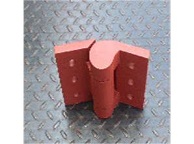
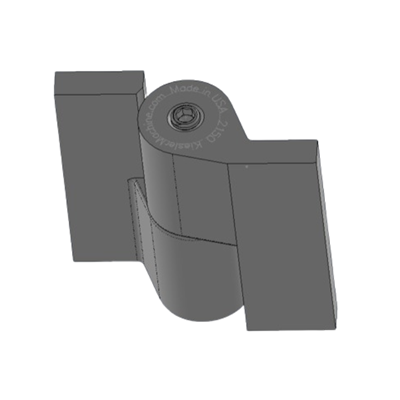
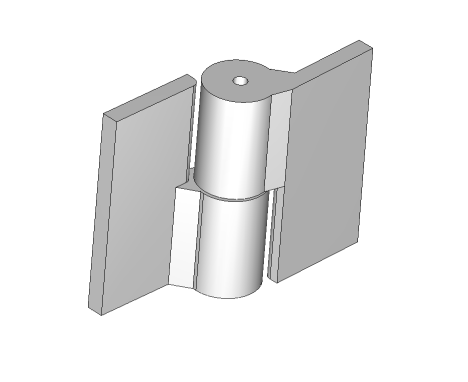
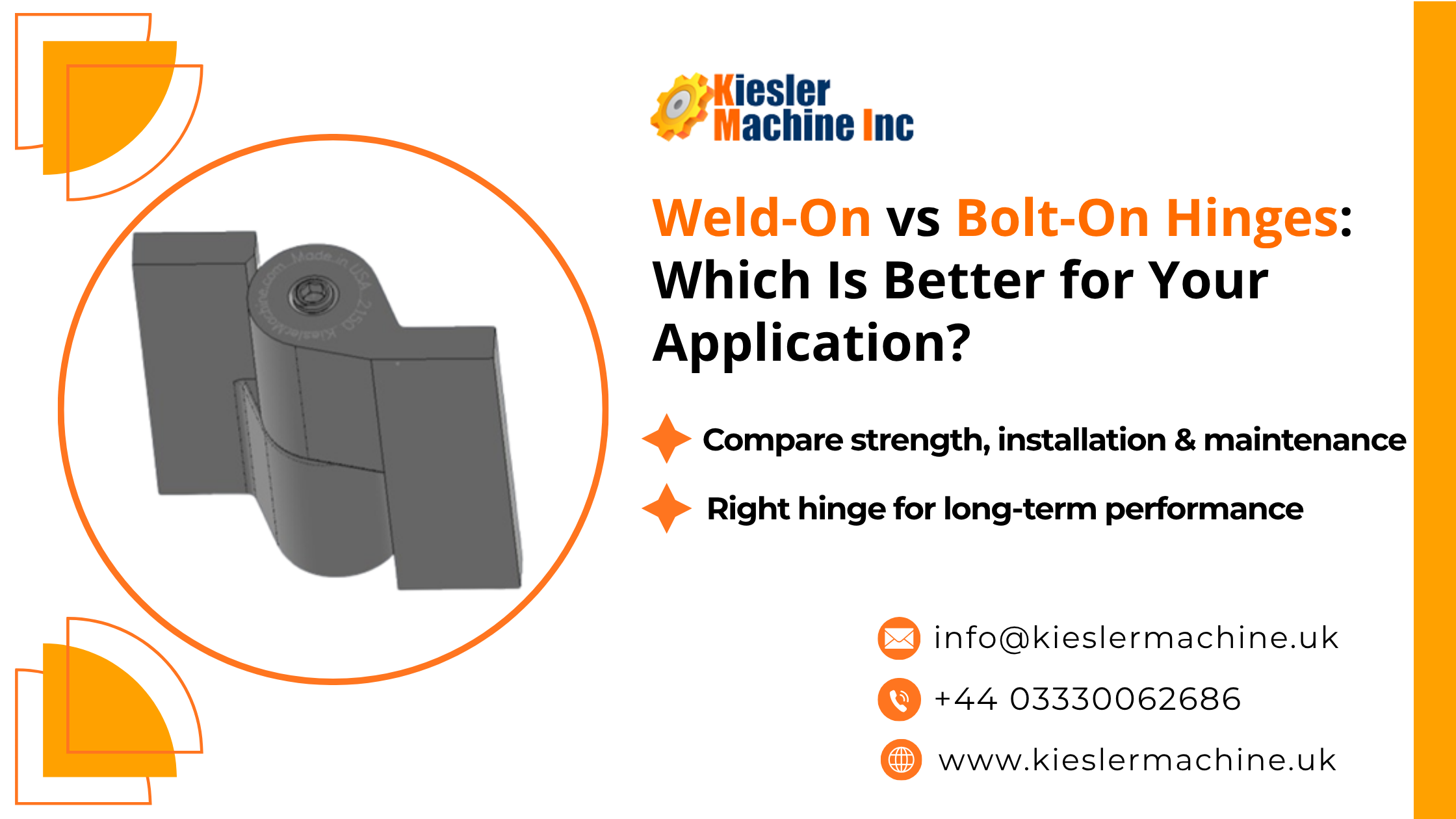
Weld-on hinges, sometimes referred to as weld-in hinges, are designed to be permanently attached to the steel substrate using welding techniques. Rather than featuring pre-drilled mounting holes, these hinge leafs are fused directly onto the door leaf and frame during fabrication.
This method creates a continuous bond between the hinge and the parent material, effectively making them a single unit. Weld-on hinges are commonly used in heavy fabrication environments and industrial security doors, agricultural applications, shipping containers, vault doors, and large steel gates.
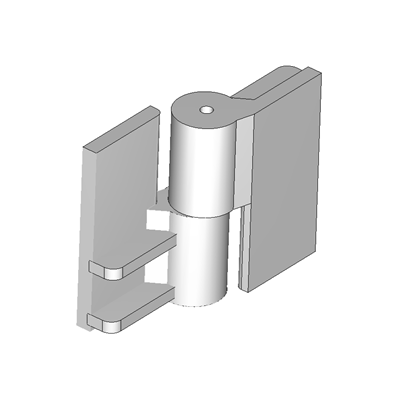
Bolt-on hinges are fastened to a door or frame using bolts or screws through pre-drilled holes in the hinge leaf. They do not require any welding, making them suitable for installations where welding is impractical, prohibited, or where future adjustability is needed.
Bolt-on hinges are widely used across commercial construction, HVAC enclosures, refrigeration units, medical equipment panels, and a broad range of OEM applications throughout the UK and Europe.
The most obvious distinction lies in how each hinge type is installed.
Weld-on hinges require welding equipment and a skilled operator. The installation is typically carried out during the fabrication stage, before surface finishing or coating is applied. This is ideal in fabrication shop or factory settings where controlled conditions are available.
Bolt-on hinges, by contrast, can be installed on-site with basic hand tools. This makes them far more accessible for field installation, retrofitting, or situations here bringing in welding equipment is not practical or cost-effective.
For example, if your project is shop-fabricated with access to welding, weld-on hinges offer a seamless fit. If you're working on-site or retrofitting, bolt-on is the more practical route.
For truly demanding applications, heavy industrial doors, vault enclosures, or high-security gates, weld-on hinges consistently deliver superior structural integrity. The welded joint distributes stress across a broader surface area, eliminating the localised stress points associated with bolt holes. This makes weld-on hinges particularly well-suited to applications involving high cycle frequency, significant lateral loads, or extreme weight.
Bolt-on hinges, when correctly specified and properly torqued, are structurally robust in their own right. However, over time and under heavy cyclic loading, the fasteners may experience loosening, fatigue, or pull-through, particularly if the substrate material is softer or if thread engagement is insufficient.
Kiesler Machine UK's heavy-duty weld-on hinges are rated for load capacities from 1,000 lbs right up to 40,000 lbs, making them an industry-standard choice for the most demanding UK and European industrial applications. For extreme load capacity and permanent structural performance, weld-on hinges have the edge.
Here's where bolt-on hinges take a clear lead.
In applications where future adjustment, maintenance, or replacement is foreseeable, bolt-on hinges offer a significant practical advantage. They can be unbolted and repositioned or replaced without specialized tools or the need to re-finish the surface. This is particularly relevant in industries like food processing, cold storage, HVAC, and medical equipment manufacturing sectors, where hygiene standards, equipment upgrades, and routine maintenance are ongoing concerns.
Removing a weld-on hinge, by contrast, requires grinding or cutting, which is messy and noisy. This adds time, cost, and downtime to what might otherwise be a routine maintenance task. Where serviceability matters, bolt-on hinges are the smarter long-term choice.
Weld-on hinges are, by their nature, restricted to weldable substrates, carbon steel and stainless steel being the most common. They are not suitable for timber-framed doors, fibreglass enclosures, or composite materials.
Bolt-on hinges offer far greater material versatility. They can be used on steel, aluminium, GRP, timber, and virtually any material that can accept a threaded fastener. This makes them the go-to solution in mixed-material assemblies or where the primary structure is non-ferrous. For non-steel substrates or multi-material assemblies, bolt-on hinges are the only viable option.
In architectural or high-specification commercial applications, the visual finish matters.
Bolt-on hinges are installed after surface finishing, meaning the parent material can be painted, powder-coated, or galvanised before the hinge is fitted. The result is a clean, finished appearance with minimal disruption to the surface treatment.
Weld-on hinges, conversely, must be welded before any surface coating, which means the weld area requires grinding back, touching up, and recoating. For finish-critical applications, bolt-on hinges make the installation workflow considerably cleaner.
Neither hinge type is inherently more expensive than the other at the point of purchase. The cost difference lies largely in installation and convenience.
Weld-on hinges require skilled welding labour and equipment, adding to installation cost. However, in fabrication environments where welding is already part of the production process, this marginal cost may be negligible.
Bolt-on hinges reduce installation complexity and labour time, particularly for on-site work. However, if the substrate requires reinforcement plates or inserts to prevent pull-through, this adds material cost and installation time.
Over the lifecycle of a product considering potential maintenance, replacement, and downtime bolt-on hinges often deliver a lower total cost of ownership for serviceable equipment, while weld-on hinges deliver better value in permanent, high-load structural applications where longevity is paramount.
To make this more actionable, here's how we typically advise clients across key UK and European industries:
Ask yourself the following questions before specifying your hinges:
The choice between weld-on and bolt-on hinges is not a case of one being universally superior it's a question of fit for purpose. Weld-on hinges excel in permanent, high-load structural applications where the substrate is steel and long-term stability is non-negotiable. Bolt-on hinges shine where flexibility, serviceability, material compatibility, and ease of installation are the priority.
Understanding your application requirements, material, load, environment, and maintenance expectations is the starting point for making the right specification. And if you're unsure, speaking to an experienced heavy-duty hinge supplier in the UK will save you time, money, and frustration down the line.
Share this: